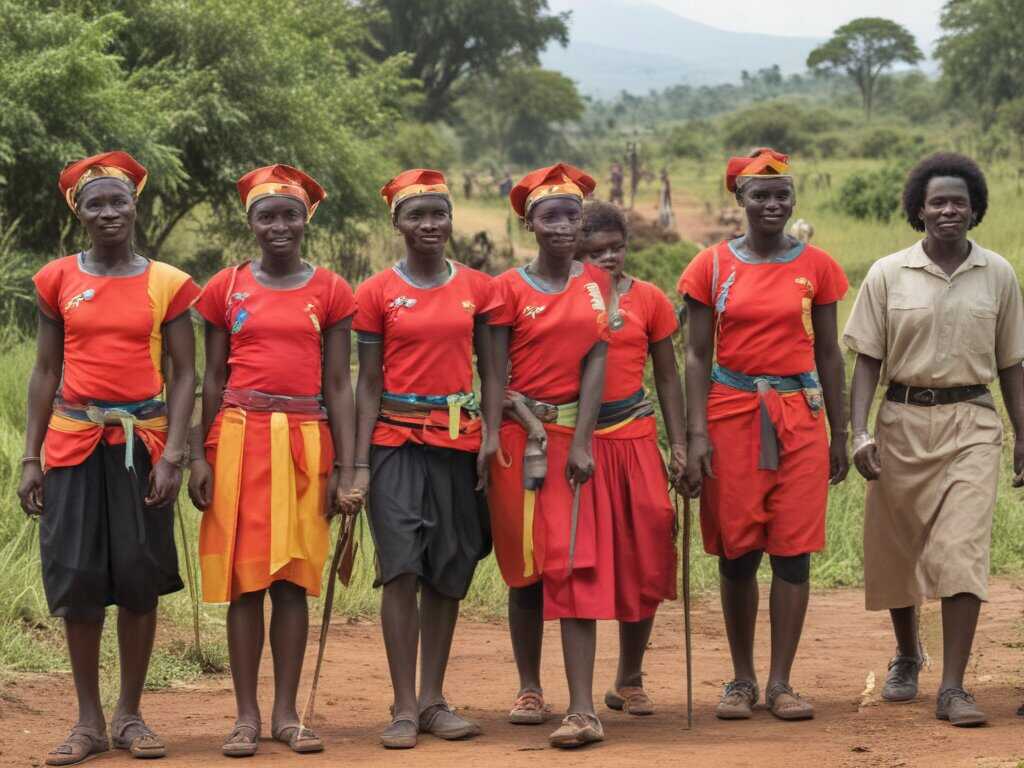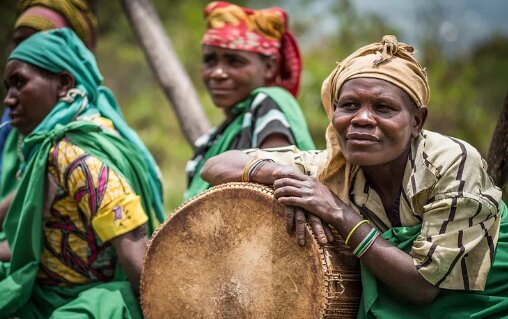

The Bantu group of people makes the majority population in Uganda. They are in 4 major kingdoms in Uganda. This Page is about the coming and migration of these people and their effects to Uganda.The word Abantu itself, incidentally, simply means "human beings". These tribes all have ntu as a core language in common, while their own languages usually comprise many dialects and variations. The ethno-linguistic Bantu group is most commonly said to have its origins in Western Africa (Cameroon). They are part of the Niger-Congo language family and have strong ancestral affinities with a group of languages being spoken today in southeastern Nigeria.
They came from Central Africa, from where they began to expand to other parts around 2000 BC. These migrations are believed to have been the result of an increasingly settled agricultural lifestyle: although needing little land (far less than herding cattle use), land had to be fertile and well watered for cultivation to be a viable alternative. Population pressure in Central Africa may therefore have prompted the first Bantu migrations.
They had entered southern Uganda probably by the end of the first millennium A.D. and they had developed centralized kingdoms by the fifteenth or the sixteenth century. Their languages are classified as Eastern and Western Lacustrine. The Western form comprises the area surrounding East Africa's Great Lakes (Victoria, Kyoga, Edward, and Albert in Uganda).
To the Eastern group belong the Baganda people (whose language is Luganda), also included are the Basoga, the Bagisu people, and many smaller societies in Kenya, Tanzania, and at the Zambezi River where the Monomatapa kings built the famous Great Zimbabwe complex.
Movements by small groups from the Great Lakes region to the southeast were more rapid, with initial settlements widely dispersed near the coast and near rivers, due to comparatively harsh farming conditions in areas further away from water. Pioneering groups had reached modern KwaZulu-Natal in South Africa along the coast by 300 A.D., and the modern Northern Province (formerly called the Transvaal) by 500 A.D.
It is not clear when exactly the Bantu had moved into the savannahs to the south, in what are now the Democratic Republic of the Congo, Angola, and Zambia. Such processes of state formation occurred with increasing frequency from the 16th century onward. They were probably due to denser population, which led to more specialized divisions of labour, including military power, while making emigration more difficult, further due to increased trade among African communities and with European and Arab traders and the Coast people (Swahili) along the coasts (Indian Ocean), with technological developments in economic activity, and new techniques in the politicalspiritual ritualization of royalty as the source of national strength and health.
The Bantu expansion was a millenia long series of physical migrations, a diffusion of language and knowledge out into and in from neighbouring populations, and a creation of new society groups involving inter-marriage among communities and small groups moving to communities and small groups moving to new areas.
Bantu speakers developed novel methods of agriculture and metalworking, which allowed people to colonize new areas with widely varying ecologies in greater densities than huntergatherers, the homeland people (original habitants of these regions). Meanwhile in eastern and southern Africa, Bantu speakers adopted livestock husbandry from other peoples they encountered, and in turn passed this form of living on to hunter-gatherers (San people), so that herding reached the far south several centuries before Bantu speaking migrants did. The linguistic and genetic evidence of all this supports the theory that the Bantu expansion was one of the most significant human migrations and cultural transformations within the past few thousand years in Africa.
Several successive waves of migrations over the following millennia followed on the tracks of the first. They were neither planned nor instantaneous, put took place gradually over hundreds and thousands of years, allowing plenty of time for Bantu culture to spread and be influenced by other cultures it came in contact with, either through assimilation or - rarer, it seems - conquest.
Bantu culture most likely reached from the west, and possibly the south, some time between 200-1000 AD, having passed through what is now the Democratic Republic of the Congo (formerly Zaire). By 600 AD they had dispersed over enormous areas, covering what is now Tanzania and Mozambique on the East-African coast, south as far as the southern African coast and west into parts of Angola. The result of all this migration and integration was the development of more than five hundred Bantu-related languages sprinkled around this area of Africa.
The history of the Bantu migrations itself is some what confused, last but not least because the on-going process of fusion and mutual influence with neighbouring peoples meant that the tribes we know today did not actually emerge as distinct groups until about five hundred years ago at the earliest. And as the Bantu people met and absorbed other peoples, they also adopted some of the assimilated peoples' histories and traditions.
As cultivators, the Bantu sought out abundantly watered areas, often in the highlands, and they were the first to start large-scale forest clearance for cultivation, with the result that even today many Bantu areas suffer enormous losses of topsoil each year through erosion.
Although the new-comers were frequently displaced, and though they sometimes fused with previous Bantu immigrants, Cushitic peoples (from whom some pastoral practices were adopted) or the hunters and gatherers they came in contact with, the essence of the Bantu identity remained the same, namely the reliance on agriculture, and hence a relatively settled way of life.
Other Bantu cultural elements that have survived, and not just in Kenya, are cosmological beliefs, such as the belief in a single creator god, and, further, the belief in the survival of ancestors as spirits or intermediaries between the living and god.
The Gusii, Kuria and Luhya of Lake Victoria are the descendants of possibly the earliest Bantu groups to have arrived and are believed to have introduced iron smelting and the use of iron tools to the region. Although it is obvious that the Bantu must have moved north to populate the areas they cover today in Uganda and Kenya, the oral legends of the central highlands Bantu invariably point to the north - usually the Nyambene Hills which lie north of Mount Kenya - as their place of origin (ie. some five hundred years ago).
From there, as their oral histories say, the ancestors of the present-day Kikuyu, Meru, Embu, Chuka and Kamba, and possibly others as well, migrated south into the foothills of Mount Kenya itself, where they eventually dispersed to their present locations. This would indicate that once in Kenya, the Bantu headed much further north than their present territories, and were pushed back by either the Nilotics or Cushites.
This theory is backed-up by other oral histories which state that the central highlands Bantu came not from the north or west, but rather from the Indian Ocean coast to the east. The coastal Bantu themselves - the 'nine tribes' of the Mijikenda, together with the Pokomo - are unanimous in that they came from a semi-mythical place called Shungwaya in the north, which is likely to have been in what is now Somalia.
The Bantu society
It seems that a long time ago many Bantu societies were organised along matrilineal lines and were governed by women; a whole heap of oral legends testifies to this, and female founding ancestors - where they exist in tradition - are as venerated and respected as their male counterparts.
Being a settled culture, the Bantu were inherently at risk of attack from the mobile nomadic Nilotic and Cushitic cattle and camel herders such as the Masaai, Borana (Oromo) and Somali, and as a result many Bantu societies became characterised by their defensive nature. Bantu groups lived on open land (ideal territory for the herders), having preferred, for both economic (agricultural) and defensive reasons, to occupy the less accessible highland regions.
Settlements were built with the greatest attention to defence and were also well concealed: Europeans found they could be walking only metres from a settlement without knowing of its existence. Some tribes, like the Kikuyu, became experts at adapting and adopting to new realities, and rarely resorted to conflict. Others, like the Chuka, developed an array of inventive defensive measures, ranging from ingenious traps to tree houses and fortifications.
Almost all the Bantu groups also adopted a rigid system of age-sets (an idea possibly borrowed from the Hamitic or Cushitic peoples they came across), in which all people of similar age were initiated into an age-set, which together progressed through clearly defined phases of social responsibilities, functions and status, from initiation, through warriorhood, marriage and elderhood to death.
The system ensured the cohesion of society, as well as enabling the development of the warrior system, by which all the young men of a given society would, shortly after initiation to adulthood and their age-set, take up the role of defending the entire society.
Nowadays, the Bantu's reliance on agriculture and latterly trade has meant that they are by far the richest people, at least in monetary terms. The downside is that their settlements are inevitably densely populated, a problem which has grown acute over the last few decades.
Bantu Traditional Songs and Dances of Bantu Women
The music of women in Bantu tribes is quite often part of the fabric of expression, which tells us who they are, not individually, but as a group - not in challenge to their culture, but in harmony with and support of the dominant and dynamic patterns of their culture. The songs and dances can be understood fully only by a tribe member, but we can benefit from an approach that looks at the textual content, the style (which includes their approach to composing), and the function of the songs and dances.
There is a conflict of presenting and, no doubt, mis-representing the dances and songs that have been extracted from the Bantu cultures. The weight of this wrong is proof to the vital interconnectedness of music and ways of life and meanings in Bantu culture. This has been said of many African cultures. Some Bantu-language have an expression for this loss of value in such an extraction:
"You can take a feather from a bird, but when you get home that will not make you fly." In this way, music reflects a deep belief in the power of music to keep their life and culture alive. The traditional songs in women's lives, which they accompany, give proof for this. Thus, what we can see of the music and dance is out of context, but nonetheless all of its elements and expressions are purely reflective and confirming of life as it is in the culture of its origin.
Also, we would have myopic view of women in Bantu cultures if we did not examine the African musical sensibilities that are the broader attitude towards music within culture. "Like a ritual or a musical event, an African community, too, is basically an ordered way of being involved through time.
Africans rely on music to build a context for community action and, analogously, many aspects of their community life reflect their musical sensibility". Conventional to Western understanding of music is the identification of a work or song as a production of a single composer. However, composership in the African music system is not usually known to be authored by a particular individual.
Either all the music is truly collaborative (not the case) and/or it is not important that individuals are credited with its creation. Music is often understood as a product of divine as well as mundane natural rhythms that are interpreted by villagers collectively. Again, music does not form a separate entity (from dance and from the holistic and daily culture); it is a communal production.
Women, especially, have the solidarity of the other women and do not need to take individual credit for the composition they have created. Also, much of the song material is retained from generation to generation. The security of the form and the song allow for some freedom within it. The structure is so well known that individual women, especially dominant in voice, will improvise above that and thus transform aspects of the fabric of that song.
The women who live this music do not seek originality but harmony. Especially in the group work songs it is clear that knowing the song and how it helps one to go about one's work in the village is more important that who first sung the melody. African women derive power and strength from social structure. It seems clear that we often consider women who defy social standards to be most powerful.
An African woman expresses in her music that she is empowered by her positions as fixed by her culture. The song or dances, in their lyrics and in their place within a woman's world, provide an affirmation of identities such as mother, tiller of the earth, grinder of meal, midwife, socializing teacher or elder, or spiritual guide. The songs can be explicit messages to the community or a particular part of the community.
They can be functional, providing necessary rhythms for human activity. Also, they can be narrative of an ongoing event or of well-known individuals. The women are the guardians of the life circle, from birth, through productivity and to death and again to birth.
Musical elements that reflect the importance of a song within the unity of village women include: call and response, reassurance of participation (common inconverstion, too), apart-playing. "Africans respect ritualized social arrangements to externalize and objectify their sense of relationship because if a relationship is to be meaningful to them, the recognition one person gives another must be visible outside their own private involvement."
- Bantu Work songs identify the women as the workers: the tillers of the earth, and grinders of the corn, maize etc. The song utilizes the rhythm of the hoes hitting the earth and also guides the synchronized movement on the field of all the women. Thus the song develops a unity of rhythm on the microscale: the synchronized swinging of the hoes makes the work easier; but also on the macroscale: the symbolism of their common effort. They sing to remind each other of the worth of their work, as if to say, "We do this for the life of our families." The song is functional and explicit in it's purpose.
- Bantu Birth attendants, or midwives, of a village explain the role of a group of women. Their role in the village was mostly respected and a source of pride for them. The song, sung in the mother tongue of the region, is simple because its text - a "jingle" about a successful birth due to the presence of the midwife - is most important and it is sung with an accompanying dance. The song itself varies in melody.
- Bantu Lullabies - The syllables (or vocables) are soothing and repetitive. There is some word painting in that the lull and the sleep lyrics fall and lilt in the vocal line. We do hear the "rhythms of sleep", though perhaps for lack of cultural similitude the song sounds less subdued than we are accustumed to hear in a lullaby. A part of the text says, "Don't you dance on your feet, they must be lulled and feel the rhythms of sleep." The child is dependent on the mother (on whose back she rests) for mobility. In the culture of this song children are not allowed to cry if they can possible help it. This song seems to be especially insistent for that reason. The lullaby is functional and expressive of the woman as mother-socializer and caretaker.
- Bantu Morality story, to be told to a group of young girls. Old women grandmothers are also socializing agents. The grandmothers specifically have the duty to teach the girls lessons on hard or embarassing topics. They say that their mothers are too shy to preach to their own daughters in this way. The woman, especially as an elder, is the holder of the license to teach ethics to the young. Even in modern times, the primary female schoolteachers, and choir leaders in church, compose music and song to teach moral ideas to children. Hymns are set by women so that they can be sung in the home by the family, and school children learn songs that teach them to have gratitude for their elders.
- Bantu Life cycle - Women are major participants in the ceremonies of all the stages in traditional everyday life. When a new child is born, the women rejoice the occasion robustly. The child is the child of all the village women, not just his or her mother's. The choral texture of the example song is reflective of this sentiment.On the occasion of initiation ceremonies of girls, old women beat drums, and the initiates, in Vinda culture, move through the village in a snake-like formation to express their belonging to this stage of life.
- Bantu Wedding celebration is marked by uproarious group singing as the women congratulate their age mates whom they will 'lose' to the husband's family, but who will now become a true and useful member of the community.
- Bantu Dirge songs - Even at the occasion of death, a woman is given the sacred right to sing the dirge. This is a Bantu cultural requirement of women for several days after a death in the family.
Map Showing Bantu People in Uganda
If you are not a historian,it will be hard for you to understand the categories of people living in Uganda.Uganda is composed of two main groups of people ie the Luos and the Bantus.
On this page we will give you details about the Bantu people in Uganda and their different categories.Take your time and learn about them as we have compiled wonderful information from migration to settlement and then their culture.
They are a group of people who speak related languages and have similar social characteristics. They occupy a large part of Zaire and southern as well as eastern Africa.
They are said to have originated from somewhere in the Congo region of central Africa and spread rapidly to the Southern and eastern Africa. (Today, more than one half of the population of Uganda is related to this group of people.)
Map of Causes and Routes Taken by bantu people
They are said to have settled in Uganda between A.D. 1000 and A.D. 1300. Some reasons are given to explain why these people moved from their original homeland to come to settle in Uganda. One reason is that they might have been overpopulated and therefore some groups decided to move away in search of vacant lands on which to practice agriculture.
Another reason given is that they might have moved away just in search of fertile lands or due to internal conflicts within their communities or external attacks by their neighbors.
Other reasons suggested include diseases and natural disasters which might have made them uncomfortable in their homeland and so they decided to move away.
One other reason is that they may have been encouraged to move away in quest of adventure and this was because they had invented iron tools which enabled them to confront wild animals and other obstacles during their movements.
Having moved away from their original homeland, the Bantu who settled in present Uganda include;
The Baganda, the Banyoro, the Batooro, the Banyankole, the Bakiga, the Bafumbira, the Basoga, the Bagwere, the Banyole, the Bagishu and the Basamia-Bagwe.Click here for more information on these tribes in Uganda.
Though there are striking similarities in language and customs among the different Bantu groups, each group has its own peculiarities in customs and other social arrangements
Map showing Bantu Migration and Effects of Bantu Migration to the People of Uganda and east africa in general
The coming of them to Uganda had many effects. The most obvious among such effects is that they led to the settlement and increased the population of eastern, central, and southern Uganda.Click here to know more about Uganda History They are also credited with introducing iron working to Uganda people. Although it is not yet clear whether it was the People or the legendary Bachwezi who introduced iron working in Uganda, We still believe that they might have come with the idea because their movement coincided with the Iron Age A.D 500-1500).
It is also stated that they introduced centralized governments of the type that existed in the kingdoms of Buganda, Bunyoro-kitara, Nkore and Toro, Igara and Buhweju.Click here for more information on culture of all bantu tribes in Uganda
The assertion however has raised a number of theories. Some historians assert that the idea of centralized government could have been an indigenous one.
They attribute state formation to the Bachweziwhom they say were Hamites from Ethiopia who were of either Portuguese or Greek origin. Such assertions are presently not taken very seriously because they contain a lot of bias against the idea of African initiative.
It can therefore be tentatively stated that these people as part of Uganda people brought the idea of centralized state formation while these assertions are subjected to further research.
They are also said to have introduced agriculture to Uganda people. This is true because their predecessors were essentially hunters and gatherers. In addition to agriculture, they also introduced crops such as millet and Sorghum.
Uganda Bantu Art and Crafts
Native art was very popular; Africans have adopted from the immigrants only as much as seemed to be in accordance with their way of life. Many defended their tribal traditions against Islamic influences, later on also against the Christian religion. The figured-plastic art Black Africa has become renowned for has not achieved the same level of importance among all peoples.
Some tribes regarded the decorative painting of their huts or pottery as being more important, others held the carving of masks in great esteem. Among the Bantu people, sculpture was highly developed, its destribution quite clearly demonstrating that women assumed social supremacy.
Uganda has a wide array of handicraft products, ranging from basketry, mats, ceramics, beads, pottery, hand textiles and woven products to toys, jewellery, bags, leather products, batik and wood craft, etc. These items are produced in all districts and regions, using local raw materials and with tribal ornaments in limited edition based on culture, history, and traditions.
Handicraft is a cultural tradition and predominantly a cottage industry, practised by the rural youth of both gender, but mainly by women in the country, in order to supplement their incomes. It has been tradition to hand over craftsmanship and skills from generation to generation. This tradition has been on the wane over time. There can even be found real masters of craftsmanship.
The production of handicraft, however, has seen an upswing as a new industrial branch, and it is perceived as a potential business for a sustainable family income, thus making modern art more and more attractive for artists, traders, and at last for export.
Some of Uganda's arts and crafts are actually the musical instruments such as drums, thumb pianos, stopped clay and reed pipes, lyre fiddles, and rattles. Some cast-iron bells are carried on the dancer's legs.
Uganda Bantu Traditional Houses
The houses are made of a double layer of plaited bamboo filled with clay (framework with clay coating) and roofed with grass or banana thatch, although now more frequently with the ubiquitous African corrugated iron roof.
The forms of the huts were like those of beehives, cupolas or squares, with the body construction being made from wood, palm leaf rips or bamboo. The walls were covered with clay, bark, or braided mats. Some tribes even painted ornaments onto the clay covering.
Uganda Bantu People Traditional Clothes and Bark cloth
Before Arab traders brought cotton into the country, there had been used fibres of the banana plant or the bark of the Mutuba fig-tree (Ficus natalensis).
Bark cloth – it has its origin in Uganda and is a purely vegetable fibre. No cloth is like any other cloth – there definitely is a huge selection of the most diverse soft natural colours from brown to different colourings.
One of the finest materials from which Ugandan artists produce their handicraft is bark cloth, a fibrous if coarse material scraped off a fig tree. Lubugo as it is called in Luganda is made from the bark of a fig tree after being soaked in water for a few days before artisans hammer it out with a toothed mallet into a fabric.
The fabric comes out in various browns, some of a very rich dark brown colour. Bark cloths hold a high place in many rituals in the kingdoms of Buganda and Bunyoro where princes and princesses were obliged to wear them. Yards of it, for example, are used to screen or drape the walls of shrines and god's homes.
Kings wear them - particularly of a white colour - on the occasion of big commemorative ceremonies; chiefs swear by them while wearing yards of it knotted at the shoulder, with a spear in hand. And during burials, dead bodies are wrapped up in bark cloth. In the early days of kingdoms in Uganda, notable chiefs would be buried in wrappings of up to 200 pieces of mbugo.
Today, since the revival of the kingdoms, bark cloth has regained its prestige with many Baganda making all different kinds of robes out of it, including very attractive hats that bear the Buganda insignia, coats, and long flowing robes.
Kanzus, which today are white cotton robes, are nowadays still worn by men (these are long white tunics with a collar-less neck and embroidered red thread that streams down the middle). Kanzus were modified after Arab dresses which first came to Uganda when slavers traded in ivory.
The women wear wrappings made from patterned textiles (which usually are imported from Kenya or Tanzania), or a gomezi, a dress in Western style with tapered shoulders. (There is a story about an Asian tailor called Gomes after whom the women's dress was named.)
Ugand and Traditional Bantu Blacksmith
The blacksmith, whose handling the fire creates magic ideas, very often also assumes the role of a priest (medicine man) or the creator of ritual figures.
Normally, however, he was a craftsman who worked iron and who was responsible for the creation of daily articles, utensils, tools, and arms: spears, pastoral sticks, catapults (shotguns), arrowheads, knives, hoes, axes, bowls and so on.
Extraordinary masters of their craft had the honour to design and create articles for chiefs, clan chiefs and the king, with this articles made from iron being embellished with special ornaments and decorations. Catapults (shotguns) and pastoral sticks were produced by the nomad tribes in northern Uganda.
Uganda Traditional Bantu Pottery - Gourds
There are various types of pottery in Uganda with most of the pots and earthenware saucers being made of kaolin, clay, and dark soil. Skilled potters slurp the clay and roll it in their hands as they carve products out, without using a kick wheel. Many tribes use clay to make smoking pipes, pots for carrying water and cooking purposes.
They have many gourds, and some of these gourds are used as the traditional containers for beer. When halved into two, gourds make good beer drinking bowls. Some long-necked gourds are used for collecting drinking water, while others are used for keeping salt or cow butter. Many artists in Uganda write on the gourds, or embroider them with tiny beads before sale.
Huge gourds are used to carry banana wine on the occasion of funerals and weddings. As a matter of protocol, such gourds have to be draped with yellow banana leaves and gently put on top of dry banana leaves.
Uganda Traditional Bantu Basketry
Elephant grass and palm leaves provide for the raw material used for mats, baskets, and also woven bee baskets; they are also used to build traps for wild animals. Today also hand bags and wall hangings are made for decorative purposes.
There are several types of baskets made in Uganda, most of these items are finely and fancifully coloured with dye solutions to create intricate patterns and designs, which constitute the products of skilled craftsmen and women.
The Batooro (Toro) and Bahima from Ankole (Nkole) of western Uganda produce fine, little cylindrical baskets (endiiro) in which millet bread is served and kept hot. In Buganda, however, the baskets are bigger, and coffee beans, fruits and even bottle beer are often served in these.
At modern ganda weddings, men and women dressed up in kanzu and boding line up with the baskets (bibbo) as they approach the bride's home on the introductory (courtship) occasions.
Beautifully hand-woven beer basket made from grass. These items are very scarce and absolutely unique. There is used a special type of grass.
This only grows in certain areas high up in the mountains, and days are spent to harvest it. Secondly, the dyeing process is also a cumbersome one, since only certain natural plants are used for this. Once the grass is dyed, it is very, very tightly woven to form the most beautiful patterns.
These beer pots are used by the men to take along their home-brewed beer or sour milk (Amasi) when going away from home for hunting. Because they are so tightly woven, they will never leak and keep the contents very cool, even on the hottest days.
They are dipped into water from time to time and then hung in trees, where the slightest breeze will chill the contents. These unique items are unfortunately becoming very scarce, and there are only a handfull of people who still weave the pots.
Hand-woven sewing basket with lid. These items are woven from wild reeds, and certain strands are dyed with colours from natural sources like plants and fruit, and then woven into the basket to form lovely patterns.
Absolutely beautiful hand-woven clutch bag. These items are woven from wild reeds, and certain strands are dyed with colours from natural sources like plants and fruit, and then woven into the basket to form lovely patterns.
Uganda Bantu Sculptures and Masks
The Europeans, for a very long time, were not able to recognise the cubic and surrealist forms of the Black Africans, as they were rooted in the system of Greek ideas.
It was hard for them to make out spiritual visions and formalistic solutions in art out of these "idols". In the centre of this system there was placed the human figure, but not, however, in its natural proportions; there was put stress on what had spiritual importance, hence this led to the creation of these abstract forms.
Art was primarily a service offered to religion – abstract concepts like divine power, divine greatness, grandeur, stillness, and death had to be modelled artistically, but they were not to have great similiarity to human beings as these would have been considered presumptuous.
For peoples without script, art constituted a natural form of expression. It was language to be understood by all. It tells of tribal history, of myths and legends. It confers the dignity necessary to the sacral actions performed.
Sculptures were expressions of invisible and supernatural powers. These articles were used in various cult performances. Sculptures, indeed, had a general symbolic value; altars and temples were built in their honour. Animal sculptures were erected for power and protections and as guardians.
Masks were expressions of supernatural powers, too. In the mask dances, divine power was mediated, the dancers were only medium tools. By means of mask performances, threats stipulated by the demons were eased, and the good spirits were asked for help.
There were also dances for the time period before sowing, after successful harvesting, for rain and also for the fertility of the tribes. Dancers with face paintings in the form of circles, dots and stripes very often substituted masks; maybe this even was the original form of the mask.
Art and handicraft were especially practised by the whole community (the villagers) during the dry seasons when there was not so much work to be done. Especially skilled artists were promoted, and some of them were called to the royal court.
Thereby, their standard of living was guaranteed, and they had a very high status. Initially, the sculptures corresponded to a social necessity, as they defined collective sense and order and regulated the relations with the supernatural powers. Later on, this led to prestige and decoration.
Cotton trees, ebony and mahagony trees provide for the raw materials needed. This sort of handicraft was especially developed among the Bantu people, whereas the nomads (pastoral tribes) did not cultivate this type excessively.
These figures and masks, made (carved) from wood for ritual purposes, as well as other daily articles in ebony and mahagony wood have thus ceased to have great religious importance. Tobacco pipes have been developed into mass products and are intended for the sale to tourists.
Uganda Traditional Skins and Batiks
The technique is thought to be more than a thousand years old, and historical evidence demonstrates that cloth decorated by means of this resist technique was in use in the early centuries AD in Africa, the Middle East, and in several places in Asia. Although there is no sure explanation as to where batik first was "invented", many observers believe that travellers brought it to Asia from the Indian subcontinent.
Melted wax is applied to cloth before this is being dipped into dye. Wherever the wax has seeped through the fabric, the dye will not penetrate. Sometimes several colors are used, with severl steps of dyeing, drying, and waxing.
Thin wax lines are made with a tjanting (canting, pronounced chahn-ting) needle, a wooden-handled tool with a tiny metal cup with a tiny spout, out of which the wax seeps. Other methods of applying the wax to the fabric include pouring the liquid wax, painting the wax on with a brush, and applying the hot wax to a pre-carved wooden or metal wire block and stamping the fabric.
One indication of the level of craftsmanship in a piece of batik cloth is whether the pattern is equally visible on both sides of the cloth. This indicates the application of wax on both sides, either with the canting or with mirror-image design blocks.
The finished fabric is hung up to dry. Then it is dipped into a solvent to dissolve the wax, or it is ironed between paper towels or newspapers to absorb the wax and reveal the deep rich colors and the fine crinkle lines that give batik its character.
The invention of the copper block or cap developed by the Javanese in the 20th century revolutionised batik production. It became possible to produce high-quality designs and intricate patterns much faster than one could possibly do by means of hand-painting.
Uganda Traditrional People Gemstones – Jewellery
Jewellery - Humans have adorned themselves with jewellery as far back as history can tell. In Uganda, people have used jewellery made from animal parts such as bone, horns, feathers, teeth, and from stone, seeds, wood, clay and precious metals, etc. to adorn themselves. There were also produced amulets, necklaces or beads, arm and leg rings with ornaments, bracelets, rings and needles for headdresses.
In the commercial crafts sector, however, jewellery is relatively new, with imported beads as necklaces, bangles, waist beads, etc. dominating the local market. Earrings and finger rings constitute the other items in this sub-group.Uganda Traditional Material – Processing and Colours
- Wood was processed by means of an ax with a transverse scrabbard, a transverse ax. It was either polished with soot or fatty mixtures or treated with the juice from roots and leaves. Subsequently, it was put in a slurry bath.
- Clay was formed by hand, without the help of a potter's wheel. The clay sculptures from Luziva in Uganda are especially famous.
- Ivory, originally considered the symbol for power and sought-after as hunting trophy, was extremely skillfully processed into arm rings and masks, or it was simply carved. Many of these amulets acquired a warm, red-brownish colour through the contact with the skin or the rubbing of tukula (redwood powder) and oil into it.
- Iron was processed to spears, knives, tools etc. The processing of iron dates back to 1,500 before Christ.
- Bronze was casted together with zinc and lead and hence got its yellow colour, giving it the name "yellow cast".
- Gold and silver were also processed in earliest times. In the regions dominated by the Islam, silver was preferred.
- Wickerwork – Leaf fibres, the stems of banana plants as well as different grass types provided for the starting material. The processing was handwork in the literal sense of the word: hands, feet and teeth were included into the work process. Baskets, bowls, sieves, shields and mats (which were also used as decoration and wall hangings) were produced. Some time later, there followed the development of weaving by means of the loom.
- Leather was especially liked by the pastoral tribes and hunters and hence processed by them. The Masaai were particulary fond of this material and painted harmonically balanced abstract designs on their leather shields. Women wear leather decorated with fringes and a huge amount of pearls and Kauri-scrolls.
- Pumpkins (gourds) with patterns and motifs decorated with figures or geometrical designs.
- Colours were dominating, especially white, black, and red. These are colours of mineral, animal and vegetable origin.
- White (supernatural powers, danger and death) - Black (earth)
- Red (energy)
List of Major Tribes in Uganda
Baganda People and their Culture
Banyankole People and their Culture
Bakiga People and their Culture
Batooro People and their Culture
Acholi People and their Culture
Alur People and their Culture
The Bachwezi People and their Culture
Bafumbira or Banyarwanda People and their Culture
Bagishu People and their Culture
Bagwere People and their Culture
Bakonjo and Bamba People and their Culture
Banyole People and their Culture
Banyoro People and their Culture
Basamia-Bagwe People and their Culture
Basoga People and their Culture
Batwa or Bambuti People and their Culture
Japadhola People and their Culture
Kakwa People and their Culture
Karimojongo People and their Culture
Kumam People and their Culture
Langi People and their Culture
Lugbara People and their Culture
Madi People and their Culture
Metu People and their Culture
Okebu People and their Culture
Sebei People and their Culture